Wooly Bear caterpillars with their broad bands of bristly black and brown hair are a familiar fall sight in much of the US. Children everywhere greet them with delight, and many teachers look upon them for lessons in lifecycles and metamorphoses. The very things that make them amenable to lessons in the classroom, can make them a gardener’s nightmare.
Wooly Bears are very adaptable to weather and seasonal changes. Depending on temperature and food availability they can produce 2 – 5 generations a year. Unlike many other caterpillars and garden pests, they can feed on a wide variety of vegetation. You may not see them most of the year, because they tend to hide. They feed and spin their cocoons at ground level, and the adults are short lived moths that fly at night. But when autumn is nearly upon us those wooly bears get restless, and wander about. The generation of wooly bears that we find in the autumn normally sleep through the winter in any cozy dry spot they can find. They wake in the spring, feed for a few weeks if they need to, and then spin their cocoons.
If you find a few of these fuzzy guys wandering around your yard, you might ask your child’s classroom teachers if they would like to raise them in class. Perhaps your kids might want to keep them as pets or as a science project. Hand raised wooly bears should have a container with loose sand or soil on the bottom and some pieces of bark to crawl on and hide under. They will be happy to eat clover, dandelion, and plantain leaves (and really, just about any leave you offer them). Prop the leaves up in their container so they are not laying flat. When the wooly bears quit eating, give them a layer of dry leaves to hid under and place their container in a cool dry, shady spot where you won’t forget them. Mist the leaves slightly once a week or so, to keep the wooly bears them from dehydrating. Check on them once in a while and if they are moving around offer them a clover, plantain, or dandelion leaf or two. If they eat it and stay active feed them more. If they don’t eat, put more dry leaves in their container and find a quieter, colder spot for them to rest. An unheated garage or shed is ideal, but the coolest quietest corner of the classroom or the driest spot in the play yard, may do in a pinch. In spring the wooly bears may wake up very hungry. Once they are nice and fat they will spin cocoons and within a few weeks the moths will emerge. They do not feed as adults, and only live long enough to mate and lay hundreds of eggs. If you have raised at least one male and one female they may start a new generation in captivity so the children can appreciate the whole cycle of their life.
I know the gardeners out there (and most of you reading this are gardeners) are saying, “Two to five generations a year, eat a wide variety of vegetation, lay hundreds of eggs, and she is suggesting we let a single one live?” Well, there are so many hungry creatures out there waiting to devour wooly bear moths, eggs, and immature caterpillars that it is a wonder any make it all the way to fall. And even those bristly fuzzy caterpillars are sought out by skunks, who roll them around on the ground until the bristles all fall off, and then they have lunch. (And you thought skunks were all bad?)
Now, I will be the first to admit that any wooly bears I find, when there are no handy kids to give them to, I promptly squish. I didn’t always do that, but after they mowed down my forget-me-nots, and then moved on to my artichokes, they are goners. I also depend on an army of hard working beneficial creatures to keep wooly bears, and other caterpillar populations in check. Those large yellow and black garden spiders that weave the perfect Halloween webs catch their fair share of moths. Lady bugs and lace wings, both adults and larva will happily eat insect eggs and young of many kinds. Wasps love caterpillars. And while a wasp is no match for a full grown wooly bear, they eat their fair share of the young hatchlings. And there are more hungry creatures in natures garden.
Huge Jerusalem crickets, those scary looking guys that are often called potato bugs or skeleton bugs are also fond of ground living caterpillars like wooly bears and cut worms. And then there are those giant science fiction California Glow worms, they look like giant millipedes and have glow in the dark spots and pulsating stripes. These natives are voracious predators of all ground dwelling pests, including our cute caterpillars and our slimy slugs. Raised beds, that provide good drainage, filled with a soil mix high in organic matter, and topped off with a coarse non-compacting mulch - are the best ways to insure these hungry creatures will make a home in your garden. And there are even more ravenous creatures waiting to serve your gardening needs.
The tiny braconid wasps, cotesia wasps, tachnid flies, and trichogama wasps all parasitize caterpillar eggs or larva, often killing their hosts quite dead. You can attract these little useful creatures for the cost of a few flower seeds and a little garden neglect. Braconid wasps like cosmos, sunflower, & marigold flowers. Cotesia wasps like mustard, carrot and sweet alyssum flowers. Tachnid flies like dill, parsley, and clover flowers. Last but not least Trichogama wasps are fond of wild carrot, dill, and golden rod. All of these little guys like aphid honey dew – them aphids are not all bad. For more information on Beneficial Insects see:
http://harvestsgardeningsecrets.blogspot.com/2006/05/beneficial-insects.html
So, here’s the basic caterpillar plan. Squish on sight, or give them to delighted children or classroom teachers. Ignore skunks and wasps to the best of your ability. Ignore small populations of aphids. Let the mustard and wild carrots grow and flower – even if the neighbors think they are weeds. Grow some of the flowers listed above and let them reseed. Welcome the tiny flying insects that are attracted and rest assured they are causing caterpillar nightmares. Keep adding organic matter to your soil and mulch with coarse plant material to attract ground dwelling predators. This is just a little bit of work and a whole lot of letting nature take its course. Some wooly bears will survive, but don’t forget, a few caterpillars (and aphids) munching a few leaves on your vegetables will stimulate the plants to make anti-oxidants and you will be the healthier for it!
Photo: http://www.whatsthatbug.com/caterpillar_2.html
Scroll down to: Isabella Tiger Moth, which is what the adult form is called.
More information on Garden pests:
Aphids
http://harvestsgardeningsecrets.blogspot.com/2006/08/aphids-are-among-us.html
Gophers
http://harvestsgardeningsecrets.blogspot.com/2006/03/gophers-and-gardeners.html
Stay tuned, next we will be planting the very yummy garden swedes and rutabagas. Meanwhile, you can probably find me out in the garden, Digging the Dirt.
Copyright 2006 Harvest McCampbell, from my column "Digging the Dirt," published in The Hoopa Valley People Newspaper, Sept. 19, 2006. Posted here with permission.
http://www.hoopa-nsn.gov/enterprises/newspaper.htm
Tuesday, October 10, 2006


Tuesday, October 03, 2006
Colorful Carrots
When we think of carrots, the color orange most commonly comes to mind. However, in the long history of human - carrot associations, this has not always been the case. Archeologists have found carrot seeds stored in ancient dwellings since Neolithic times. These ancient carrots had little resemblance to the carrots on our dinner plates today. They were very much like those wild white sweet roots that Native children are fond of foraging from fields and meadows. While sweet, these roots are fairly tough and most often completely white. It is assumed that Neolithic people gathered the wild roots for food and that the carrot seeds were also gathered for their medicinal and flavoring possibilities.
More recently but still long ago, in fact as long ago as five thousand years, folks in the Middle East began the first known intentional cultivation of carrots. They selected or developed some larger rooted purple carrots, as well as some bi-colored carrots that somewhat resembled the purple topped turnips that abound in markets and gardens today. These carrots spread through out the Middle East and Europe by as early 1000 AD. At this time carrots were still not the delectable vegetable we know today. While sweet and nutritious when young, they were fairly tough customers, and they had a tendency to grow woody and bitter as they aged.
By the tenth century AD yellow carrots were developed in Turkey, through careful selection. These new yellow carrots reached Holland by the fourteenth century. Within a couple hundred years the Dutch had selected out orange carrots that were well on their way to resembling the carrots that we know and love. (Meanwhile all this time, in South America the Indians had their own carrots – Arracacia, of which I can find very little information. The facts are intriguing, the plants are perennial, are grown much like potatoes, and each plant can produce up to 2 kilos of edible roots per year. Now, that is a bunch of carrots! But since I can’t find a source for seeds or plants, we will have to stick with growing these European carrots, for now.)
Fashions do change, in clothes and carrots. Things once considered old fashioned and out dated return as the new rage. A close look at some of the larger seed catalogs will uncover a glimpse of carrots in many colors. The historical colors of carrots, long out of vogue are back in force. And with them are some colors the ancients may have never imagined. Atomic Red and Purple Haze are some of the newest hot carrot colors. You can even buy Rainbow packets with tender sweet carrots ranging from white, through yellow, to pale shades of the more familiar orange.
 |
| Over wintering colorful carrots from Growing Together Community Gardens, where you will find a little more info. |
Carrots make an excellent fall and winter crop here in the Pacific North West.. If you get them started early enough, you can even grow them in areas that get substantial snow. Once the snow starts falling the carrots will stop growing. But they will start again as soon as it thaws out in spring, giving you an extra early crop. The rest of us can start our carrots pretty much any time of year, as long as we can provide them with plenty of water. However, carrots grown through the winter are extra fat, juicy, and sweet.
"After several frosts, plant starches become sugars. Carrots attain the sweet crunch of apples, and kale loses all hint of bitterness." Fred Bahnson, Soil and Sacrament.
 |
| Purple topped carrots can get huge! Learn more here. |
If you want to grow more carrots than can be done in an assortment of containers, and gophers are problem, raised beds underlined with hardware cloth are the answer. Hardware cloth is a metal mesh material available at most hardware and garden supply centers. It is not cheap. It is available in 3’ wide rolls, and generally sells for upwards of $2.00 - $3.00 a foot by length. Make sure the hardware cloth you purchase is galvanized. The good news is that it lasts for many years.
Most raised beds are 3 feet wide by six feet long. When designing the beds make sure that the outside measurement of the frame is 3 feet, so you have plenty of space to securely tack your hardware cloth to the wood, preventing gophers access to the beds. For carrots it is a good idea to have beds at least 12 inches high, higher might be even better. I am happy with my 12” x 1” boards hammered together and screened on the bottom. They are simple, not too expensive, and they look just fine.
For growing carrots in raised beds you may want a planting mix that contains a good amount of sand - if you can get it, lots of organic matter, and a lesser amount of plain old mineral soil. A nice loose mix that will resist compaction is ideal. If you are going to make your own, screened compost or leaf mould makes a good starter, purchased sharp sand is ideal – but river sand will do, and a few shovels full of your own garden dirt makes a good addition. You can also purchase planting mix, if you like. Just ask the nursery what they would recommend.
Fill your beds loosely, water well to settle the soil, top off the beds and repeat and level as needed. You want your soil to settle to within 2 inches of the top of your raised beds. Beds or containers filled too high will loose soil to rain and watering, but those without enough soil will cramp the root development of your yummy and nutritious carrots. (If they weren’t so dang good, and good for you too, they really wouldn’t be worth the trouble. Nothing much taste sweeter than a fresh pulled carrot.)
Now you are ready for seeds. I would bet that almost all nurseries and garden sections of hardware stores stock at least a few varieties of carrot seed. You might even be able to find them at your favorite grocery store. But if you want to amaze friends and family with fat ones, skinny ones, long ones, and short ones, as well as red, white, and purple ones, you will probably have to hit the seed catalogs.
The two best catalogs I’ve found, as far as carrot selections go, are Johnny’s Selected Seeds and Thompson and Morgan. You can request a free catalog from both these companies. Johnny’s Selected Seeds is enough to make any gourmet gardener drool. They carry 17 different varieties of carrots, including all the fancy colors and shapes listed above. You can request a catalog by phone, 877-564-6697, or on the Internet: http://www.Johnnyseeds.com Thompson and Morgan offers a whopping 19 different varieties of carrots, and while some of them over lap with Johnny’s offerings, they both have some unique selections. You can contact Thompson and Morgan by phone, 800-274-7333, or on the Internet: http://www.Thompson-Morgan.com
When ordering or purchasing your seed, consider getting some scallions, shallots, or bunching onions too. Carrots inter-grown with any of these alliums are much less susceptible to carrot maggots, who can eat tunnels through these tasty roots. I have not had any problems with carrot maggots here in Hoopa, but I was occasionally bothered by them when I gardened down in the Sacramento area. Rotating your carrot plantings each year and soil solarization can help if carrot maggots get to be a problem.
If you still want to know more about carrots, check out the carrot museum: http://www.carrotmuseum.co.uk/ They have information on everything from carrot antifreeze to carrot quotes, great classroom and rainy day activities, and much, much more.
Articles On Other Fall and Winter Veggies:
Broccoli, Fennel, Giant Red Japanese Mustard, Kale, Kohlrabi, Parsnips.
Copyright 2006 Harvest McCampbell, from my column "Digging the Dirt," published in The Hoopa Valley People Newspaper, Sept. 12, 2006. Posted here with permission.
Updated with a quote, photos, and minor editing on 11.16.16. Text and photos, copyright Harvest McCampbell. Please feel free to share via the buttons below. All other rights reserved.
Tuesday, September 26, 2006
Fall Flowers
Summers heat has begun to subside and our days are turning mild and breezy. Once again it is a joy to be out in the garden among the flowers and bees while the sun warms work weary shoulders. Many of our favorite blooms are fading to seed. But there are still some garden stars to enjoy through the months of fall. Here are some ideas for both fussy gardeners and those who like to take it easy.
One of my farorite plants for autumn is the lovely and delicate California Fuchsia. They are also known as Zauchneria and Epilobium. But no matter what you call th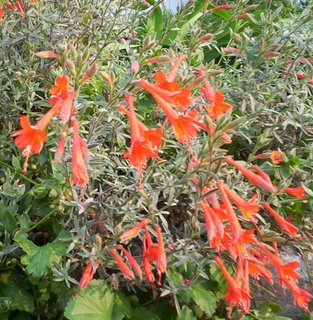 em, their firecracker flowers will decorate your borders from mid summer through mid-fall. They are perennials in most temperate parts of Northern CA (hardy to zone 7). You just have to plant them once and they will grace your landscape for years to come. These fabulous little flowers bloom in shades of red and orange, depending on the variety you choose. Their narrow tubular flowers are perfect for hummingbirds, who definitely love the nectar. If you plant blooming specimens now, those glitter feathered birds may visit your yard well into fall.
California Fuchsia is attractive in the garden, even when not in bloom. There are varieties that are used as ground covers and in hanging baskets. These creepers come with fuzzy or smooth, narrow, grey or green leaves. They look graceful spilling out of a container or over a ledge. I am particularly found of the grey leaved types. They add color and texture to the landscape even when they are out of bloom. There are other varieties that form what are called “sub-shrubs.” These plants grow up to 3 feet tall, depending on the variety. The taller specimens deserve a place in the middle of the border. There are varieties that range up to about 2 feet tall that look great inter-planted with roses. They can serve to hide the roses stubby ankles and knees. Just make sure you choose colors that harmonize in a way that pleases your eye. Read plant labels or catalog descriptions thoroughly, to be sure you choose plants that are right for the spot you have in mind.
Zauchnaria, as I am in the habit of calling it, can be planted anytime now through spring. If water is a problem in your area, plant in the fall after the rains have begun. (You may not get flowers this year if you have to wait.) By summer this hardy native plant will have sunk its roots deep enough to withstand most of what summer can dish out. The soil needs no special preparation and they are bothered by few pests. (The slugs don’t even bother the ones in my yard.) Good drainage is helpful if you can provide it. In the summer they prefer to be a little on the dry side, so consider the moisture needs of other near by plants when choosing Zauchnaria’s special spot. They love the sun, so give them plenty of exposure. If your plants get a little raggedy looking over the winter try to wait until the end of February before giving them a bit of a hair cut. That way you will preserve as many healthy stems as possible and you are sure to get a repeat performance of the autumn fireworks next year.
Another great fall bloomer hardy in our area is Mexican Bush Sage (Salvia leucantha). This sage eventually forms a fragrant shrub up to four feet tall and wide. The stems and stalks have a purple cast, and are covered with soft grey fuzz. The flower bracts are a deep purple, also covered with that same soft fuzz. The flowers themselves come in purple or white, depending on the variety. They also attract hummingbirds and tend to begin their show in late summer or early fall. In mild weather they may continue blooming through early winter. The leaves are narrow, long, crinkled, and a pleasant shade of green. Mexican Bush Sage is hardy to zone 8. It has few pests, it is drought tolerant, and it loves the sun. Much like California Fuchsia, it is not picky about soil, other than needing good drainage. While this plant is hardy in our area, you don’t often see it planted. So if you want something a little different look for Mexican Bush Sage.
Gaura, bee blossom, butterfly flower, or wand flower (Gaura lindheimeri) makes a great companion to either Mexican Bush Sage or California Fuchsia. It is a long lived perennial flower with slim flowering “wands” that grow from 2 – 3 feet tall. Many varieties have foliage and stems marked with maroon, making the plants colorful whether they have flowers or not. Gaura begins blooming in late summer and will continue throughout fall. Plants will live in sun or shade, but will flower best in a sunny spot. They are drought tolerant, have few pests, and the flowers range from white to pink, depending on the variety you choose. If you live in an area that gets a hard frost or snow, Gaura is likely to die back to the ground in winter. But rest assured, as soon as spring comes around the corner, your Gaura will come back to life.
If you are the “take it easy type,” are in a hurry for some fall flowers, and are on a budget, here’s a little secret you can use right now. There are two very inexpensive types of seeds you can purchase, and simply throw on the ground in-between your other plants and have flowers in about 6 weeks. This little trick will only work in areas that you water. It is fun to try this with your kids, and it might even make a nice class project. But you need to do it right away. Once it starts raining it will be to late to try this year.
This little trick starts at the feed store, or the bulk bins at the grocery or health food store. Look for the small black sunflower seeds they sell to feed pets, and also look for raw whole buckwheat. (You don’t want roasted buckwheat groats – they won’t grow.) Buy a quarter pound or so of each, and just toss them around where you would like them to grow. The sunflowers grow up to about 3 feet tall, and have flowers from 3 – 6 inches across. Some plants will have multiple flower heads blooming one at a time. And you should have your first flower buds in 4 – 6 weeks. They are really fast and fun. The buck wheat makes an attractive spreading plant with 2 – 3 inch heart shaped leaves and interesting jointed stems. They will begin blooming in about a month of being sown, when they are only 6 – 8 inches tall. They make sweet smelling crescents from an inch to 3 inches long, full of tiny white flowers. The plants will continue to grow until frost, forming a loose open network of arching stems and flowers. (Both the sunflowers and the buckwheat will need replanted next year, if you want a repeat performance.) Hurry, fall seems to be coming early this year.
If your local nursery doesn’t carry the perennials listed above here are some mail order sources: Forest Farm, http://www.forestfarm.com/ (541) 846-7269 They have several varieties of Gaura and Zauchnaria.
Mountain Valley Growers, http://www.mountainvalleygrowers.com/ (539) 339-2775 They have one variety each of Zauchnaria and Gaura as well as two types of Mexican Bush Sage.
Next time we will be getting ready to grow some of the new colorful carrots for a cool fall crop. Meanwhile, you can probably find me out in the garden, Digging the Dirt.
Copyright 2006 Harvest McCampbell, from my column "Digging the Dirt," published in The Hoopa Valley People Newspaper, Sept. 5, 2006. Posted here with permission.
http://www.hoopa-nsn.gov/enterprises/newspaper.htm
One of my farorite plants for autumn is the lovely and delicate California Fuchsia. They are also known as Zauchneria and Epilobium. But no matter what you call th
 em, their firecracker flowers will decorate your borders from mid summer through mid-fall. They are perennials in most temperate parts of Northern CA (hardy to zone 7). You just have to plant them once and they will grace your landscape for years to come. These fabulous little flowers bloom in shades of red and orange, depending on the variety you choose. Their narrow tubular flowers are perfect for hummingbirds, who definitely love the nectar. If you plant blooming specimens now, those glitter feathered birds may visit your yard well into fall.
California Fuchsia is attractive in the garden, even when not in bloom. There are varieties that are used as ground covers and in hanging baskets. These creepers come with fuzzy or smooth, narrow, grey or green leaves. They look graceful spilling out of a container or over a ledge. I am particularly found of the grey leaved types. They add color and texture to the landscape even when they are out of bloom. There are other varieties that form what are called “sub-shrubs.” These plants grow up to 3 feet tall, depending on the variety. The taller specimens deserve a place in the middle of the border. There are varieties that range up to about 2 feet tall that look great inter-planted with roses. They can serve to hide the roses stubby ankles and knees. Just make sure you choose colors that harmonize in a way that pleases your eye. Read plant labels or catalog descriptions thoroughly, to be sure you choose plants that are right for the spot you have in mind.
Zauchnaria, as I am in the habit of calling it, can be planted anytime now through spring. If water is a problem in your area, plant in the fall after the rains have begun. (You may not get flowers this year if you have to wait.) By summer this hardy native plant will have sunk its roots deep enough to withstand most of what summer can dish out. The soil needs no special preparation and they are bothered by few pests. (The slugs don’t even bother the ones in my yard.) Good drainage is helpful if you can provide it. In the summer they prefer to be a little on the dry side, so consider the moisture needs of other near by plants when choosing Zauchnaria’s special spot. They love the sun, so give them plenty of exposure. If your plants get a little raggedy looking over the winter try to wait until the end of February before giving them a bit of a hair cut. That way you will preserve as many healthy stems as possible and you are sure to get a repeat performance of the autumn fireworks next year.
Another great fall bloomer hardy in our area is Mexican Bush Sage (Salvia leucantha). This sage eventually forms a fragrant shrub up to four feet tall and wide. The stems and stalks have a purple cast, and are covered with soft grey fuzz. The flower bracts are a deep purple, also covered with that same soft fuzz. The flowers themselves come in purple or white, depending on the variety. They also attract hummingbirds and tend to begin their show in late summer or early fall. In mild weather they may continue blooming through early winter. The leaves are narrow, long, crinkled, and a pleasant shade of green. Mexican Bush Sage is hardy to zone 8. It has few pests, it is drought tolerant, and it loves the sun. Much like California Fuchsia, it is not picky about soil, other than needing good drainage. While this plant is hardy in our area, you don’t often see it planted. So if you want something a little different look for Mexican Bush Sage.
Gaura, bee blossom, butterfly flower, or wand flower (Gaura lindheimeri) makes a great companion to either Mexican Bush Sage or California Fuchsia. It is a long lived perennial flower with slim flowering “wands” that grow from 2 – 3 feet tall. Many varieties have foliage and stems marked with maroon, making the plants colorful whether they have flowers or not. Gaura begins blooming in late summer and will continue throughout fall. Plants will live in sun or shade, but will flower best in a sunny spot. They are drought tolerant, have few pests, and the flowers range from white to pink, depending on the variety you choose. If you live in an area that gets a hard frost or snow, Gaura is likely to die back to the ground in winter. But rest assured, as soon as spring comes around the corner, your Gaura will come back to life.
If you are the “take it easy type,” are in a hurry for some fall flowers, and are on a budget, here’s a little secret you can use right now. There are two very inexpensive types of seeds you can purchase, and simply throw on the ground in-between your other plants and have flowers in about 6 weeks. This little trick will only work in areas that you water. It is fun to try this with your kids, and it might even make a nice class project. But you need to do it right away. Once it starts raining it will be to late to try this year.
This little trick starts at the feed store, or the bulk bins at the grocery or health food store. Look for the small black sunflower seeds they sell to feed pets, and also look for raw whole buckwheat. (You don’t want roasted buckwheat groats – they won’t grow.) Buy a quarter pound or so of each, and just toss them around where you would like them to grow. The sunflowers grow up to about 3 feet tall, and have flowers from 3 – 6 inches across. Some plants will have multiple flower heads blooming one at a time. And you should have your first flower buds in 4 – 6 weeks. They are really fast and fun. The buck wheat makes an attractive spreading plant with 2 – 3 inch heart shaped leaves and interesting jointed stems. They will begin blooming in about a month of being sown, when they are only 6 – 8 inches tall. They make sweet smelling crescents from an inch to 3 inches long, full of tiny white flowers. The plants will continue to grow until frost, forming a loose open network of arching stems and flowers. (Both the sunflowers and the buckwheat will need replanted next year, if you want a repeat performance.) Hurry, fall seems to be coming early this year.
If your local nursery doesn’t carry the perennials listed above here are some mail order sources: Forest Farm, http://www.forestfarm.com/ (541) 846-7269 They have several varieties of Gaura and Zauchnaria.
Mountain Valley Growers, http://www.mountainvalleygrowers.com/ (539) 339-2775 They have one variety each of Zauchnaria and Gaura as well as two types of Mexican Bush Sage.
Next time we will be getting ready to grow some of the new colorful carrots for a cool fall crop. Meanwhile, you can probably find me out in the garden, Digging the Dirt.
Copyright 2006 Harvest McCampbell, from my column "Digging the Dirt," published in The Hoopa Valley People Newspaper, Sept. 5, 2006. Posted here with permission.
http://www.hoopa-nsn.gov/enterprises/newspaper.htm
Subscribe to:
Posts (Atom)