Showing posts with label natural pest control. Show all posts

Thursday, November 17, 2016

Beneficial Insects Love Irises!


Purple Iris, 2006, my Hoopa Garden.


Irises make an important contribution to the garden environment by attracting a variety of predatory ground beetles. The larva of these beetles live in the soil, where they consume slug eggs and slug larva.  


Dutch Iris, 2015, from Growing Together Community Gardens.


The key to putting ground beetle attracting Irises to work for you most effectively, is to plant just a few each of a large variety of Irises that bloom at different times, and spread them around the garden.  The longer you can keep the adult ground beetles happy, the more likely they will be to lay eggs in your soil.  Ground beetles also prefer soil rich in organic matter, with strategically placed sections of rotten limbs or other untreated wood, to use as daytime shelter and nursery areas for egg laying.  

Learn more about developing healthy organic matter rich soil and attracting beneficial insects by clicking on the 'labels' found directly under the share option buttons found beneath this post. 

~~~

Text and photos copyright 2016, Harvest McCampbell. Please feel free to use the buttons below to share.  All other rights reserved.

Friday, August 14, 2015

Avoiding Mosquitoes in the Garden


File:Mosquito Tasmania.jpgBit or not?  What you eat matters!

I rarely get bit, but today I did, twice while at the community garden.  These were my first mosquito bites for the year and I spend a lot of time outside.  My main question was "Why?"  Why now? Why am I suddenly getting bit? 

This lament was followed by asking myself what I have been eating that I usually don’t.   I answered myself, dairy including yogurt.  Next I asked myself what I hadn't been eating much of that I usually eat lots of, and the answer was garlic and onions.  Then I did some research . . . .

First I found that mosquitoes are attracted to lactic acid; and dairy products, particularly yogurt and other fermented and aged dairy products like cheese, are high in lactic acid.  

Next I found that eating garlic and onions discourages mosquitoes.  

And then I found that apple cider vinegar also discourages them, and guess what?  I have been off my vinegar as well . . . 

I have always known that eating red meat attracts mosquitoes.  I am not much of a meat eater, which may be part of the reason they usually leave me alone.  I do eat 3-oz servings of salmon 5 times a week, and twice a month or so I usually have some other fish, sea food, or chicken--but I don't eat red meat more than once or twice a year--if even that often.  The science behind this, is that uric acid attracts mosquitoes . . . .

Turns out that people who eat a vegan diet have the highest levels of uric acid.  And it also turns out that vegetarians and people who eat fish but no meat have the lowest uric acid levels. So we can see why I rarely get bit.  I am usually avoiding foods high in lactic and uric acid which attract mosquitoes while eating the garlic, onions, and apple cider vinegar that discourage them!

Food matters!  Here's a quick recap:  Dairy, meat, and a vegan diet can help attract mosquitoes.  Fish, garlic and onions, and apple cider vinegar help repel them.   However there is more to the story, please read the links below for the whole scoop on the other foods you may be eating that may be making you especially yummy to mosquitoes.  No time to read them all?  The secret is that real food is your friend, and junk food is your enemy!  But we already knew that, didn't we?

Taste Horrible to Mosquitoes: 4 Foods to Avoid and 2 to Eat:

Why do mosquitoes like me more than anyone else?


Mosquitoes: What To Eat to Avoid Getting Bitten:

Serum uric acid concentrations in meat eaters, fish eaters, vegetarians and vegans:

~~~

Photo courtesy of Wikimedia Commons

~~~

Have tips on naturally avoiding mosquitoes in the garden?  Please leave a comment!

~~~

Please feel free to use the buttons below to e-mail, re-blog, tweet, share, or pin this post.

Tuesday, August 11, 2015

Slug Control


When we find damage in our yards and gardens that resembles the poor rhubarb on the right, careful eyes are very likely to discover that the slugs are out of control.  

Organic slug control begins with nurturing the soil.  Soil may seem like an odd place to start a discussion on slug control, but the easiest way to control slugs over the long term is to invite slug predators to do the job for you.  Slugs are at their most vulnerable to predation as eggs in the soil and as tiny hatchlings that live for months beneath the soil surface.  To permanently reduce slug populations we need to think about our garden soil as a living and complex ecosystem.

 
E.O. Wilson, in the Nova DVD, Lord of the Ants waxes poetic about the soil beneath our feet.  He mentions that most people think of the surface they walk on as two dimensional.  However, he goes on to explain that soil is one of the most complex and most diverse environments on the planet.  In most natural undisturbed ecosystems this is still absolutely true.  But it may not be true in your garden, which Wilson was not considering.  

The soils were we garden have often been compacted, leveled, and groomed to death.  In addition, our gardening habits may work against the soil ecosystem.   Baring the soil to the sun causes oxidation of humus and death to most soil organisms.  Further, chemical fertilizers are toxic to most soil organisms and beneficial insects, and if your soil has ever been treated with pesticides or herbicides the soil environment has been further compromised, or possibly completely massacred. 

We can, however, turn the soil around.  This is important to slug control.  A complex living soil environment will nurture and protect the beneficial predatory insects which will happily devour slug eggs and young slugs.  By improving the soil environment, we also improve the productivity of our gardens.  That’s a double win, more productivity and less damage!

In building and nurturing living soil, we may find we need to expand our ideas of what appropriate soil care is, what we might want to dig in and bury, as well as what we think is appropriate to use as mulch.  To encourage a diverse soil environment, a diversity of organic matter needs to be incorporated into the soil.  This feeds and creates habitat for a self supporting web of life, which will help keep pests in balance and protect our gardens.
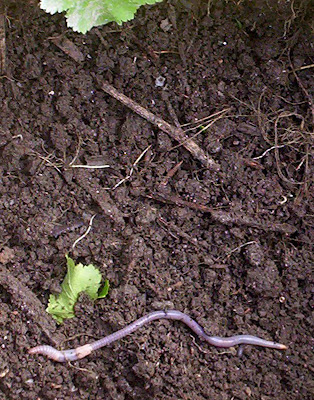
This photo is from a hole I dug in a bed in my Hoopa garden, to remove mature parsnips, garlic, potatoes, and giant snow drop bulbs.  It was about 12 inches deep, possibly a little more.  I didn’t work the soil after digging.  That's just what the bottom of the hole looked like.  And, by the way, I didn’t need a shovel, I just used my hands.  The important things to note are that there are different types and different sizes of organic matter present.  And the soil, even though it is moist, is a loose assortment of various sized crumbs.  This is your goal!  Soil that is crumbly, full of air spaces and organic matter of different types and sizes is exactly what plant roots need, exactly what the soil nutrient cycle needs, and exactly what the predatory insects that dine on slug eggs and slug hatchlings need as well.

You can achieve soil like this, easily, and without spending any money.  Everything you need is probably already produced in your garden and kitchen!   This technique is a variation on an old fashioned and little known British technique.  It is variously called garbage gardening or trash gardening, and it utilizes all kinds of organic matter.  In this technique, the garden row is prepared by trenching,  the trench is then filled with organic matter including kitchen waste, weeds, and other garden debris,  which is them buried under at least six inches of soil, and the resulting mini berm is then planted.  My modified version has been named “The Compost Hole Method” by my friends, and just uses planting holes instead of trenches.  Some of my friends have further adapted the technique to their gardens, environments, and resources.  At the community garden where I am now the coordinator, we have re-adapted the technique once again; using wide trenches and probably a full ton of weeds buried under eight inches of soil.  The two photos below show two different groups of tomato plants grown in the same garden, one over the trenched and buried weeds, and the other of tomatoes that were planted in our soil in an area that was tilled, top dressed, and then had finished compost worked into the planting holes.  The tomatoes on the left were grown over the buried weeds, the ones on the right by more traditional organic methods. The difference is amazing!


Burying your compostables including weeds, garden debris, and kitchen waste pays dividends, the very first season!

"Soil both craves life and wants to produce more life, even a hundred fold."  Fred Bahson, Soil and Sacrament, page 3.

Before we get going on the Compost Hole Method, which you can modify back as a method to prepare whole rows or to prepare wide beds, I want to share a little secret with you.  Amongst all the other organic matter you will utilize in building your living soil environment, you will want to include short sections of sticks and stalks. They are the secret ingredient for super powering organic slug control in your garden.  


Many of our garden plants produce strong stalks when we allow them to flower and begin the process of setting seed.  Clip the excess stalks into sections from about 2 – 4 inches long.  These carbon rich sticks provide plenty of surface area for beneficial bacteria, protozoa, mycelium, and other beneficial soil organisms to colonize, and the green plant matter that forms the skin and pith of the sticks (as well as the other organic matter you will be burying) provide the beneficial microorganisms with food.  As the sticks and stalks are colonized and broken down, they often become hollow.  

The combination of this hollow structure and the presence of beneficial organisms creates the perfect home and food source for the tiny soil living creatures that devour slug eggs and young slugs before they emerge from the soil.  These predators will arrive in your garden as eggs laid by their mothers.  They do not come out of their eggs big enough to slay slug eggs.  They need other smaller organisms to devour while they grow.  The hollow sticks, in addition to offering them an excellent food source, also provide them with shelter from larger predatory soil creatures.  Your soil is definitely going to be a jungle of tiny creatures.  But that’s the way it should be, and it will make your work so much easier!

In the post on Slimy Slugs, I mention creating a coarse mulch of clipped sticks.  This mulch of clipped sticks is important to mature slug predators, but now you also know how important it is to include some of these sticks in the soil itself.  An abundant garden will produce enough of this material to provide for both needs, however, it may take a few years of soil building to get to the point that you have enough sticks in production to do both.  If you don’t have a source of fresh sticks and stalks to clip, check out the straw offered for mulching and bedding at your local feed store.  Most straw is actually the leftover stalks from a variety of grain crops.  Look close at a bale, and you should see that it contains hollow tubular stems.  While these stems will decompose faster than most garden stalks will, they will serve you very well until you get an ample production of stalks from your own garden.    

Check the straw out before buying, to make sure it has fairly sturdy hollow stems.  You don’t want hay.  Hay decomposes too quickly, it has very few hollow stalks, and it is full of grain and weed seed that will sprout in your garden.  Be sure to clearly ask for straw and check it out before you purchase it.  Yes, yes, I know I did say that you could do this without spending money, and you can.  It will just take a little longer if you don’t now have fresh sticks and stalks to clip.  The fresh sticks and stalks are actually superior to straw, because they still have lots of juicy plant material that will feed beneficial microorganisms, and those microorganisms will be right inside the hollow tubes where the baby slug predators can eat them while they take shelter and grow.  Sticks and stalks are better.  Straw will help if you don’t have them.  If you don’t have money for straw, just plant extra of whatever you are growing, and let it bolt and flower—your garden can easily produce plenty of stalks in a season or two.  (Weed stalks work too!)

A couple of other sources of hollow sticks you might already have around your yard are butterfly bush and elderberry shrubs.  They both attract pollinators and beneficial insects, and elderberry has the additional benefit of producing berries that are edible and medicinal.  Once well established, both of these shrubs can withstand being cut back severely, and will generally regrow vigorously.  Once you’ve clipped your sticks, you might want to allow them to dry before burying them and using them or using them as a coarse mulch.  Sometimes those short clippings will sprout and root if you utilize them fresh.  That has never happened in my gardens, but I know of other gardens where it has happened.  Another alternative is to take your chances, and then pot any up that start to grow and share them with your gardening friends.  Fresh sticks are better than dried, but dried are better than none at all.  Meanwhile, you may have other plants that produce hollow stems, twigs, or sticks in your garden.  Give them your love, they deserve it!

Ok, let’s quit talking and get to work!  The first thing to do is build soil. We’ll start with The Compost Hole Method, and build some really fabulous living soil. Once your soil will provided a comfy nursery and larder for your slug eating predators, you will want to  attract their parents to your garden.  All you need to know is covered in the post on Slimy Slugs.

You are also going to want some help cleaning up the slugs the beneficial insects miss before they emerge from the soil.  Those mature slugs are the ones we hate the most after all.  Unless you live in the desert, toads and other amphibians are probably your best bet.  You will find lots of information here on creating amphibian habitat in your garden:  http://harvestsgardeningsecrets.blogspot.com/2010/11/hedging-for-amphibians.html 


If on the other hand, you live in a warm dry environment, you will want to create habitat for lizards and snakes.  Piles of rocks and downed wood, that have lots of protected and hidden spaces for hibernation, egg laying, and escape from predators are the ticket.  If you have a large garden, you will want to include this sort of reptile habitat in strategically located spots around your yard or garden.  Snakes prefer to enter their lair at the ground level.  Lizards generally like an elevated look out, say two to two and a half feet about ground level, with safe hidey holes directly below their look out. And since snakes will eat lizards, you might want to choose which creatures you want to attract to your garden and design with them in mind. In addition, all reptiles prefer their dens to be located in the sun, and to have flat areas for basking.   Think in terms of creating garden art as you create their habitat.  It doesn’t have to be a messy pile of unsightly rocks and downed wood.  It can totally be attractive, and it can include the odd whimsical element to make it fun for other sorts of garden visitors as well.

Speaking of other garden visitors, many species of birds also have a reputation for eating slugs.  While I have not ever personally found them particularly helpful in this regard, they do provide a wide range of pest reduction services.  Attracting birds for the purpose of getting them to eat pests is a little different than simply attracting them to feeders.  Learn more here: http://harvestsgardeningsecrets.blogspot.com/2012/01/mystery-in-garden.html

It is going to take a little time to get your garden environment productive and diverse enough to keep the slugs from over populating.  In the meantime I suspect you will be hand picking, just like me.  I am gardening in a new location and still have lots of work and planning to do!  I use a plastic bag as a glove when hand hunting slugs, and I stash them in a jar with a tight lid. While I forgot to leave any head room in the half gallon jar pictured below (don’t forget!),  I filled it with slugs in about a half hour.  Ugh!  Left in the sun for the day, the slugs were dead the next morning.  I promptly buried them for their nitrogen boost to the soil and to garden plants.  When you do this, don’t let them age in the jar, they create a terrible stink; but when buried the soil forms a filter and the microorganisms make quick work of the rest, there’s no smell at all once they are buried.  (Quick tip, dig your hole before you open the jar!)   

Beware!  Slugs can carry disease.  Before you try this, contact your health department or cooperative agricultural extension and ask if slug borne meningitis is a problem in your area.  If it is, just get yourself a couple of plastic bags that have no holes, use one as a glove to collect the slugs, and the other as a receptacle.  When you’re done, knot the bag closed with the slugs inside, and stash it and the ‘glove’ in the trash.  And be sure to wash your hands!  Slug slime is gross!  Oh, but slug slim is actually good for the soil.  It helps the soil form that very desirable crumb texture and the beneficial soil microorganisms love it.  Slugs are not all bad.  But an over population of slugs is terrible. 

We are beginning to learn to think of the garden as an ecosystem, where all things exist in balance.  The role of the gardener is to steward that balance and in return to be deeply nourished . . .

Questions?  Additional organic slug control tips?  Please leave a comment!

~~~

Text and photos copyright Harvest McCampbell, 2015.  Updated 11.20.2016 with a quote and minor edits.   Please feel free to use the buttons below to e-mail, re-blog, tweet, share, or pin this post.  All other rights reserved.

Tuesday, July 10, 2012

Sow Bugs, Earwigs, and Chilean Mesquite!


First the bugs:  

 As a few of you probably know, I recently bought a little place in Lucerne, (Lake County) California.  (Seems there are two Lucerne’s in California.)  Developing a balanced garden ecosystem takes time, and I am definitely not there yet.  In the battle between plants and bugs, in many cases the bugs have been winning.  Sow bugs and earwigs, both beneficial creatures when their populations are in balance, have been turning the leaves of many plants into an ugly imitation of lace.  

I have read and tried a number of organic and non-toxic tactics.  I finally have a success!  I made a "trap" using one tablespoon of molasses and 2/3 cup of water--which I poured into a shallow deli take out container. (The liquid was about 3/4 inch from the top.) I nestled it into the mulch around a plant that has been getting hit hard and added a couple of handfuls of mulch around the edges to provide very easy access. This morning there were probably at least 100 drowned bugs in there!  More molasses traps will be appearing in my yard soon.

Chilean Mesquite:

Creating a garden ecosystem is an effort that takes time and experimentation.  Lake County California has a semi arid climate; worse lately with drought and the solar maximum that is slowly building.  The town of Lucerne also has one of the highest water rates in the country.  Bills for two people households that do no outside watering average around $150.00 (every other month).   Even up in Hoopa, (where most of the posts in this blog originated) and before the solar maximum, I found that most garden plants benefited from filtered shade for at least part of the day.  With this in mind I have been doing some research on trees that would possibly be adapted to the climate here and that would fix nitrogen, carbon, and provide food.  Mesquite crossed my mind as a good candidate.  When a friend of mine reminded me of their thorns, I did a search on thornless mesquite and began reading about Chilean Mesquite.  

I found and ordered seeds on E-bay, and then researched how to germinate them.  The seeds arrived still in sections of their pods. (They are not easy to remove.)  I put about six of the pod sections in a heat proof dish, and then poured boiling water over them. (That was the best plan, according to what I had read on-line.)  The next day, after soaking for nearly 24 hours, I was able to work the meat off the seed capsules, cut through the capsules, and squeeze the seed out.  (It still wasn’t easy.)  

Then, carefully grasping each small seed, I scarified one edge (and my fingernails as well) by rubbing them against a piece of coarse sandpaper.  I was very careful not to damage the pointed end of the seed, where the root would emerge.  The seeds were then placed on a folded paper towel, inside a ziplock bag, and some of their soak liquid was used to moisten the paper towel thoroughly.  I read that they liked to be hot—so I placed the baggy on a warm shelf out on the sun porch, and then brought it into the house over night.  This morning, less than 24 hours later, the first seed is clearly germinating and the rest are swelling and look viable!  At least some of those little seeds will hopefully one day be big trees!  And that is part of what I live for . . .

Happy Gardening!

Tuesday, January 24, 2012

Mystery in the Garden

Last summer I noticed that the edible landscape on one side of my yard was plagued with harlequin bugs and cucumber beetles, while the other side had very few pests. Over a number of weeks I tried to determine the reason this was happening. I was hoping that I could encourage whatever it was that was discouraging my pests.

First I examined what was growing on each side of the yard. I had a number of similar plants in both locations. The few differences didn’t seem to account for the disparity. Next I looked for predators. The side with the larger pest population actually had more spiders and lizards. That wasn’t really what I expected to find. Although it makes sense – the predators were living where the hunting was good. Then one morning the answer to the mystery came to me, completely by surprise.

I was standing on the front porch leaning against the rail, absent mindedly looking over the garden and making a mental list of things that needed done. Feeling kind of lazy, I wasn’t moving much, just enjoying the early morning air. That’s when a flock of birds swooped into my neighbors pine trees just for a moment. Next they dived down into the blackberry hedge that runs along the edge of the yard. From there they darted into the parsnips and Queen Anne’s lace that had gone to seed at the far edge of the garden, right in front of the blackberries. At least a dozen little birds began feasting on the seed heads that just moments ago I had been thinking of chopping down.

Every so often one of those little birds darted into my kale and cucumbers, quickly snapping up bugs and then darting back to the dense stalks and seed heads. The mystery was solved. The neighbor’s pine trees, the blackberry hedge, and the ripe seed heads all served to attract the birds into the garden. Birds need to feel safe from predators; the blackberries and pine trees provided cover. The abundant seeds located close to the hedge offered a ready source of food. Once they felt safe and were engaged in their feast, the movement of the dastardly insects was more than they could ignore. They quickly snapped them up. This accidental arrangement of trees, hedge, and food source - provided the birds with exactly what they needed. They were taking care of my pest problems, on one side of the yard. With some planning and patience we can all get the darting darlings to dine on our pests and leave us a little fertilizer in the bargain.

First let’s take a look at providing the cover birds need to feel welcome and safe in our gardens. Pine trees or other evergreens provide year round habitat. Tall varieties near the north east of the garden will help provide the safe retreat and staging area that birds favor, without overly shading your plants. You can situate new gardens to take advantage of existing trees in your or your neighbor’s yards. Or, if you are patient and have the room, trees can be planted that will provide this benefit.

When choosing pine trees you might want to keep a few additional uses in mind. Some pines offer edible seeds when they mature. Many have decorative cones that can be used for holiday wreathes and centerpieces. A few have long needles that can be used for weaving pine-needle baskets. Below are some choice varieties that provide edible seeds, attractive cones, and that have long needles when mature:

California Grey Pine (Pinus sabiniana) is native in our area and is the source of our pine nut beads. It has long grey-green needles and very heavy cones. You won’t want those cones falling on your buildings or vehicles so give some thought to where you plant it. Hardy to zone 6; it will thrive in our valleys and lower mountain elevations.

Chir Pine (Pinus roxburghii) is native to the foothills of the Himalayas. It has bright green 9-12 inch needles; light brown medium sized cones, and is hardy to zone eight.

Italian Stone Pine (Pinus pinea) provides the traditional pine nuts of European cuisine. The long needles are borne on upward reaching branches and the cones are brown, medium sized and very attractive. It is hardy to zone seven. (I have a young Italian Stone Pine in my yard in Hoopa, where it has lived happily for several years.)

Korean White Pine (Pinus koraiensis) has 2 – 4 inch needles, small brown cones, and is hardy to zone four.

Limber Pine (Pinus flexilis) is a native of western North American. It has long yellow-green cones, 3 inch long needles, and is hardy to zone four.

That’s it for the pine trees that produce edible nuts and are adaptable to our region. The next step in attracting the darling little bug snappers is to provide an understory or hedge of shrubs, vines, or bushes. If you have a conveniently located black berry patch or an existing hedge that’s great. I don’t recommend planting black berries. We have plenty of wild ones and there are lots of other choices; a couple that you might like are listed below:

Serviceberries (Amelancheir sp.) make nice hedges, shrubs or even small trees. They are hardy at all elevations in our area and they have lots to offer the gardener. In early spring they are covered with a profusion of white or pink flowers. The flowers are followed by abundant edible berries that range in color from blue, through purple, to almost red. Then in fall the leaves put on a show of their own, turning various shades of crimson. There are a number of varieties of serviceberry available. They offer a range of tart to sweet berries and different ripening dates. They also are available in a range of sizes from small to large shrubs, all the way up to a medium sized tree. Be sure to read the plant descriptions in your catalog or on the plant label so you get exactly the right plant for your needs.

If berries are not to your liking, you might want to explore the filbert and hazelnut offerings. These nuts all belong to the Corylus genus and will happily grow in our area. Corylus have what are known as imperfect flowers. That means they have two separate types of flowering structures. The female flowers are the ones that form the nuts, while the tassels or catkins bear the pollen. Corylus sport rather small flowers, but they appear in late winter when any new color or texture in the garden is a sight for sore eyes. They are also available in a range of sizes from small shrubs to large trees. Some varieties offer spring color in the form of yellow or red new growth. A very few varieties hang onto the new foliage colors for a good part of the summer, offering a respite from gardens that are overly green.

The last thing necessary to attract birds is a source of seeds near the shelter of the shrubs, hedges, and trees. Bird feeders installed on poles are a good option. You can keep stocked year around. You can also sow seed bearing plants that will provide your garden with color and texture through the seasons. Besides the parsnip and Queen Anne’s lace I have observed the birds feasting on the seeds of kale, onions, and mulleins in my yard. These plants are all easy to grow, and once you get them started and allow them to run to seed they will come back year after.

Check your local nursery or favorite catalog for plants and seeds. If you don’t find what you are looking for, Forest Farm carries all the trees and shrubs mentioned above. They also have a number of ornamental onions listed in their perennial section under “Allium.” There are a few mulleins listed in the same section under “Verbascum.” Plants are reasonably priced, and available on their web site: http://www.forestfarm.com They have an extensive catalog (its $5.00). Call (541) 846-7269 for more information.

Previously Published in the Hoopa People News

Copyright 2007, Harvest McCampbell


Friday, June 17, 2011

Say Goodbye to Wormy Apples

Wouldn’t it be nice to go out to grandma’s apple tree and bite into a nice crisp juicy apple and not have to worry about worms? Just think of the work it would save when making apple sauce, cider, or pie. Say goodbye to wormy apples! It is a bit of work; it takes planning and careful timing. However, we can achieve worm free apples--without using pesticides-- if we know when to begin.

The nasty worms that inhabit and foul our apples all have a similar life cycle. The stage that bothers us the most, when they chew through our fruit, is their larval stage, the first stage after hatching from eggs. These eggs are laid right after our trees blossom in the spring. The larva that will soon be looking for a spot to spend the winter and turn into flies and moths come autumn. After the apples fall to the ground, depending on exactly which species of pest we are talking about, they spin cocoons or turn into pupas to wait out the winter months. Once spring is upon us, they burst from their hibernation and take to the air, ready to mate and lay eggs on our apple blooms.

The first step to ensuring worm free apples next year, is to get those wormy apples off the ground right now. If necessary, trees can be pruned, just enough so that you can get under them to clean up all the plant litter. Pruning back all branches that touch the ground is a good job for when the tree is completely dormant. Besides easing the job of cleaning up under the tree, it reduces the path ways that pests and disease follow to infect your fruit.

Once you can get under the tree to work, the leaf, fruit, and twig litter should be completely raked up. It can be fed to poultry or other animals, burned, or buried under at least three feet of dirt. Simply composting infested apples and other tree litter allows the worms to complete their life cycle and attack your fruit for another season.

Cleaning up under your apple trees before our rains set in has other benefits. It also helps prevent the tree from developing dry rot and fungus infections. These disease organisms often get their start in the duff and litter beneath trees. Once our weather begins to dry out in the spring, you will want to add a layer of compost or manure and some mulch beneath the trees drip line. This will help with water conservation, it reduces competition from weeds, and it supports the health of our all important soil organisms. Be sure to keep the organic matter at least a few inches away from the trunk to prevent disease organisms from gaining access to the bark and wood. The organic matter will provide nutrition for your trees as it breaks down. Just don’t forget to rake it up and move whatever is left next fall.

If you still have apples on your trees right now, you may want to take another step, after cleaning up the litter. Consider placing tarps under the trees, at least until all the apples fall. Some apple fruit pests burrow into the soil soon after the infected apples hit the ground. If you can block them from burrowing you will be ahead of the game next spring. (Remove the tarp after all the leaves and fruit fall, so the soil and roots can breathe.) Other apple worms climb up onto the trees trunk and hide in the bark. We can take care of these pests with Neem. Neem is natural oil from a tropical tree that is used by many organic gardeners for pest control. It is harmful to many insects, including those that are our friends, so it should be used carefully and in moderation. Certified organic farmers should contact their certifying organization to see if Neem is allowed. If not the organizations can make recommendations on other oils to use. Many horticultural oils, even those allowed by organic standards, can cause a build-up of heavy metals and other toxins in our soils and plants. Neem seems to be the safest, but it is not always allowed.

Neem oil is available from many nurseries, garden catalogs, organic farm suppliers, and natural food stores. Read the label carefully and ask any knowledgeable staff person for help if the label isn’t clear. The packaging should give directions, including dilution rates. (If you have more than one tree, or if your tree is very large, you may need something more than just a spray bottle to do the job.) Once you are ready to go, a dry still day when the bees are not busy is ideal. Consider spraying up to three times. First, after all your fruit is picked and before the rain has started; a second time in December or January, after the tree is fully dormant; and lastly, after the petals have all fallen from the tree and the bees are busy elsewhere. Thoroughly spray the bark and branches, and lightly spray the ground under the tree. Neem will not burn your plants leaves in spring, so go ahead and spray the young leaves too. Neem not only controls insect infestation it also reduces fungal infections, which is a great benefit in very wet winters. If you happen to live far away from anyone else who has apple worms treating your trees one year might be enough. However, the adult insects can fly in from several miles around, so most of us will need to spray every few years at least

If your apple trees are too big, too over grown, and too productive to undertake all this work, ask yourself if you really need trees that big. There are many very good varieties of dwarf apples available. If you are not overly attached to your old trees, you ought to consider replanting. You can keep the old trees for a few years, until the new ones get established. If you time it right, you can take out the old trees before the new ones bloom, so they just don’t hand their pest problems over to their replacements. However, the main advantage to planting new dwarfs is that their smaller size makes them easier to care for. They are just as susceptible to infestation as their larger relatives. If you do take out old trees, don’t let the apple wood go to waste. Let it age a few years and put it to good work on your BBQ or in your smokehouse. Apple wood gives food a nice, sweet, smoky flavor.

A great source of information on pruning and natural pest control can be found in the book Maintaining Your Edible Landscape Naturally by Robert Kourik. It is available by request from many libraries and used book stores.

Sources: If you are unable to find dwarf apple trees in the varieties you would like check out Burgess at http://www.eBurgess.com or call (309) 662-7761 to request a free catalog. Last but not least, if you can’t find Neem oil locally or through your favorite catalog, Territorial seed company has it listed in their winter 2007 catalog along with some spray equipment, garden tools including a pruner for branches up to ¾ inch, and a sharpener for your pruning equipment. http://www.TerritorialSeed.com (800) 626-0866.

~~~

Published in the Hoopa People Paper, October 2007, Copyright Harvest McCampbell, all rights reserved.  Republishing by permission only.

~~~

Added a photo on 11.4.16. Text and photos copyright Harvest McCampbell.  Please feel free to share using the buttons below.  All other rights reserved.

Wednesday, October 13, 2010

Thwarting Corn Worms

Copyright Harvest McCampbell, 2007, published in the Hoopa People News

Fresh corn on the cob is one of the delights of summer. Whether you like it boiled or roasted, drizzled with butter or olive oil, sprinkled with salt and pepper or chili powder; I know your mouth is set for a taste right now. Nothing is more disappointing than pulling a plump ear off the grill, impatiently waiting for it to cool, shucking off the husk, and finding you have cooked yourself up a bunch of fat grubs.

As unappetizing as those bugs may be, they won’t hurt you one bit. I am not suggesting you actually eat them, although my grandmother used to suggest that to me. I would get lectures on how nutritious bugs were; and she would further ruin my apatite with stories of all sorts of bugs Native people used to eat. I was not convinced and I won’t try to convince you. Instead I will give you some pointers to reduce the infestation in your corn and a little advice on what to do if you find corn worms on the ears you planned to eat for dinner.

An ounce of prevention is always worth a pound of cure. If you’ve had worms in your corn before, it may not be too late to thwart them this year. Check your plants to see how the ears are coming along. If they are just beginning to put out silk, here is a simple and inexpensive trick that will greatly reduce the number of disgusting worms burrowing through your favorite summer treat. All you need is a little vegetable oil, a small jar, and an eye dropper or bulb syringe. Castor oil is supposed to be the best, because it is the thickest; but any vegetable oil will work just fine.

First take a close look at your developing ears. At the top you simply squirt a dropper full of the oil into the opening through which the silk is emerging. You want to wait until the silk is at least an inch and a half long. It is important not to get any oil on the tips of the silk, because that would interfere with pollination necessary to develop plump ears.

This little trick works two ways. First of all, the worms emerge from eggs laid by moths which crawl through that same opening where you just squirted the oil. Those that are fool-hardy enough to crawl through the oil usually don’t survive the experience. Moths breathe through pores in their abdomen. The oil can clog the pores and suffocate them. If they manage to survive suffocation, the oil also ruins their wings, making it impossible for them to fly to the next young ear and lay a few more eggs. Second of all, should a moth have beaten you to the ear, the oil will also suffocate the eggs and tiny young worms. For best control, you can repeat this trick every three to four days from the time the silk emerges until the corn is ready to pick. However, if you have lots of corn and little time, you might just want to invest in the castor oil and make the application a single time when the corn is most vulnerable; just after the silk has emerged.

There is a product advertised for single application treatments that contains oil mixed with Bacillus thuringiensis (Bt). Bt is marketed as a disease that only affects caterpillars, grubs, and a few other insects. It is incorporated into a number of products that are popular with many commercial organic growers and some organic gardeners. Bt gives the bugs a deadly case of the flue. Unfortunately it also kills native species and the bacteria can multiply and spread. If that weren’t bad enough news, recent research has shown that people can become infected with Bt. While fairly uncommon; there are well documented cases of folks with lesions in their eyes, lungs, and skin. (For more information search the Internet on “Bt / Human Infection.”) Bt infection is a greater concern for workers on organic farms, the elderly, the very young, or those with impaired immune systems; than it is for the rest of us. However, if my only choice was between those icky worms that never actually hurt anyone and bacteria that might, I would stick with the worms.

There is also a beneficial insect that can help control corn worms. According to research done by Cornell University some farmers have found that a tiny (non-stinging) wasp that goes by the unwieldy name, Trichogramma ostriniae, provides better control of corn worms than provided with commercial pesticides. These wasps parasitize the eggs and larva of a number of crop pests including cabbage worms, corn worms, and a number of borers that tunnel into the stems and fruits of our favorite crops. Home gardeners can easily attract these little guys to their gardens.

Adult Trichogramma feed on pollen and nectar from clover, golden rod, and carrot family plants. Queen Anne’s lace, fennel, and parsnips are a few carrot family plants very popular with Trichogramma wasps. To make sure your little wasps have plenty of fuel for their hunt, one plan is to plant the borders of the garden with nectar producing plants. Other options include inter-planting nectar plants in your rows or beds, or sowing the walk ways between the beds with white, rose, or red clover. These clovers can be mowed, they add nitrogen to your soil, and they may help keep weeds down. However, clover also attracts bees of the stinging kind. If you or the grandkids like to walk out in the garden barefoot, clover is best kept out of the walk ways and assigned to do its work in the border or in its own bed.

For those growing lots of corn for market, you might consider purchasing Trichogramma for release in your fields. The best crop protection with the least monetary expenditure is supposed to come from releasing 30,000 Trichogramma wasps per acre when the corn is in the 4-6 leaf stage. Unless you are growing late corn, you will probably have to wait until next year to make this experiment. That will give you time to establish some nectar bearing plants to help your Trichogrammas thrive. These little insects are cold hardy, so once you get them established they just might keep working for you for many years. If you are interested you can find more information here: http://en.wikipedia.org/wiki/Trichogramma

Trichogramma ostriniae and other Trichogramma species may be available through your favorite organic gardening supplier or catalog. If not, IPM Labs grows out Trichogramma and other beneficials by special order. You will need to contact them well in advance. They can be reached by e-mail or phone: ipminfo@ipmlabs.com / 315-497-2063.

Meanwhile, if you do find a few bugs, just remove the infested and fouled part of the ear by breaking or cutting it away. Rinse the remainder well, and boil; or wrap in the rinsed husks and some foil and pop them on the grill. While this little task may not be for the squeamish, if you get it accomplished well before your meal it won’t gross out your guests. That’s a mistake I recently made, and I definitely learned my lesson.

That’s all for now folks, but stay tuned. Next week we will be talking about the very flavorful Greek oregano. Meanwhile, you can find probably find me out in the garden, Digging the Dirt.

End


Sources:
Personal experience and Cornell University research on beneficial wasps, some of it located here: http://www.cals.cornell.edu/cals/public/comm/news/archive/clean-corn.cfm


P.S. I know this post isn't timely for Northern Hemisphere readers--but I am sharing it here as part of a conversation on facebook about controlling caterpillars. Please feel free to add me on facebook and join in the conversations . . .